
Acoustic Metamaterials for acoustic improvement of spaces, acoustic structures, and musical instruments
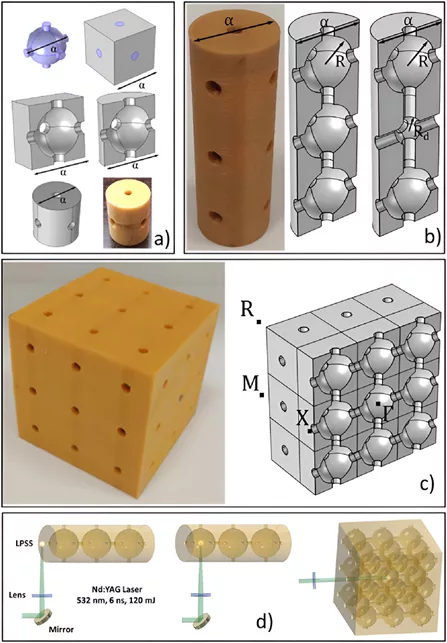
This research focuses on developing a novel method for the precise characterization of acoustic metamaterials and phononic crystals using Laser Plasma Sound Sources (LPSS). These sources, generated via laser-induced breakdown of air, are point-like, massless, and produce broadband acoustic pulses (N-pulses) spanning from infrasound to ultrasound. The method enables sound transmission evaluation in multiple directions, excitation inside the structure, and high-accuracy measurement of spectral features (band gaps, passbands), validating computational models and revealing the relationship between geometry and acoustic response.
Acoustic MetamaterialsPhononic CrystalsLPSSAcoustic Band GapsFinite Element Method
Overview
Acoustic metamaterials and phononic crystals are a promising technology for controlling and manipulating sound, with applications in noise insulation, room acoustics, sound focusing, and the development of acoustic filters. However, their experimental evaluation has been limited by conventional methods (impedance tubes, loudspeakers), which suffer from significant drawbacks: limited sample geometry, narrow frequency range, inability to excite inside the structure, and diffraction issues.
Our research group has developed an innovative characterization method based on Laser Plasma Sound Sources (LPSS). This method offers unique advantages:
- Ideal Sound Source:LPSS are generated by focusing laser pulses (e.g., 6 ns, 532 nm) in air. Laser-Induced Breakdown (LIB) creates a microscopic plasma that rapidly heats and expands, producing a characteristic acoustic N-pulse. This pulse is:
-
-
- Broadband, covering the entire audible spectrum (from infrasound <20 Hz to >20 kHz) and reaching ultrasound (>500 kHz with fs lasers).
- Point-like and massless, thus not perturbing the sample and allowing placement at any point, even inside the structure.
- Possesses high sound pressure levels (>130 dB).
- Its emission is omnidirectional(for point sources) or controllably directional (line sources), enabling measurements along multiple propagation axes.
-
-
- Measurement Flexibility:Using LPSS, we can:
-
-
- Evaluate sound transmission through structures of arbitrary geometry, free from the constraints of impedance tubes.
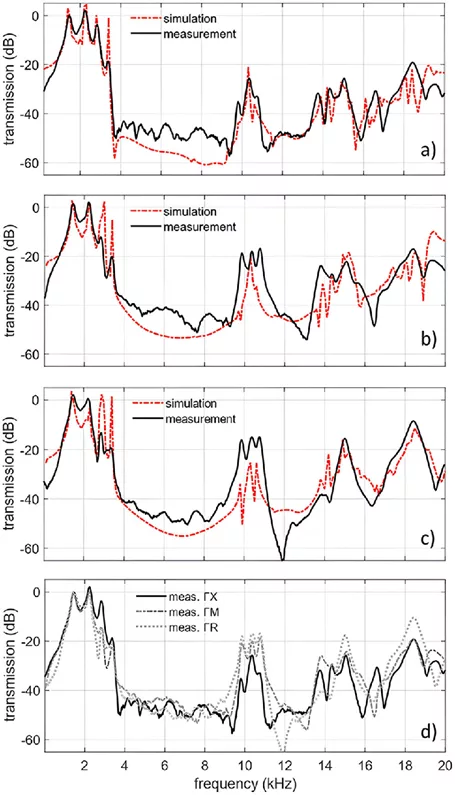
- Excite the structure from different positions (external or internal) and measure the response in multiple directions (e.g., ΓΧ, ΓΜ, ΓR for cubic structures).
- Repeat measurements with high fidelity and eliminate noise by averaging multiple responses.
-
-
- Validation of Computational Models:Experimental results are compared with FEM simulations (COMSOL Multiphysics), which model the interaction of the acoustic wave with the structure. The excellent agreement between experiment and simulation validates both the method and the models.
Key Findings and Applications:
- Precise Band Gap Mapping: The LPSS method reveals in detail the band gaps predicted by Bragg theory, detecting even gaps at very low frequencies (infrasound - few kHz), which are challenging to measure with conventional means. This capability is crucial for designing efficient sound insulation materials and acoustic filters.
- Effect of Defects: The method accurately detects the introduction of defects (e.g., a defective cell), causing a shift in resonances and the emergence of new peaks within the band gaps. This finding is exploited for developing acoustic sensors and defect detection setups.
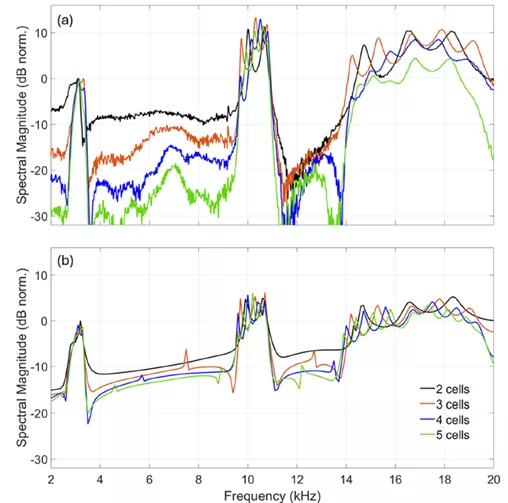
- Unit Cell Multiplicity Analysis: Studying the effect of cell number (2 to 5) on the acoustic response revealed that:
-
-
- Band gap depth increases exponentially, with 3-4 cells sufficient to approximate an infinite crystal, defining the minimum structure for practical sound insulation applications.
- Resonance peaks, attributed to spherical harmonics (l=0,1,2) and standing waves, increase with multiplicity, enabling the design of acoustic filters with controlled passband width.
-
-
- Directionality and 3D Filters: In cubic structures, the method measures the response along three different directions, demonstrating that the structure can function as a homogeneous three-dimensional acoustic filter. This property is fundamental for spatial sound shaping applications, such as focusing and directional emission.
Examples
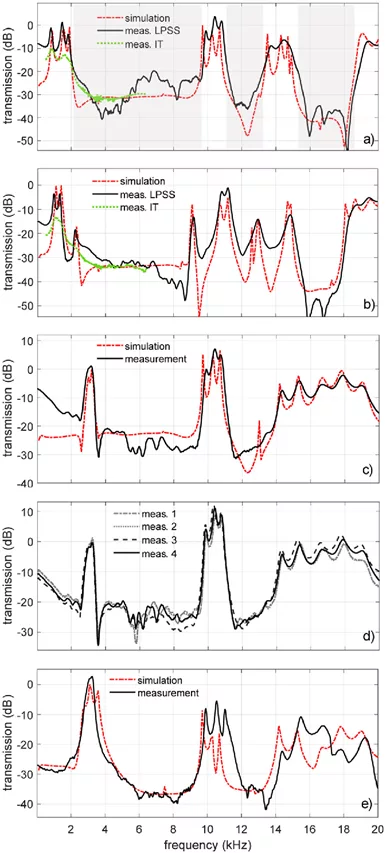
Comparison of LPSS Experiment, FEM Simulation, and Impedance Tube. Graph comparing the sound transmission spectrum through a phononic crystal. The LPSS measurement (black line) aligns almost perfectly with the FEM simulation (red dashed line), revealing detailed band gaps and resonances. In contrast, the impedance tube measurement (green dotted line) has a limited range and misses details.
Effect of Unit Cell Number. A series of graphs showing transmission spectra for crystals with 2, 3, 4, and 5 cells. The increase in band gap depth and the increase in the number of resonance peaks are clearly visible.
Measurements on a Cubic Crystal. Comparative graphs of sound transmission along the three directions ΓΧ, ΓΜ, and ΓR of a cubic crystal. LPSS shows that the response is similar in all three directions, validating its function as a 3D acoustic filter.
Publications
Kaleris, K., Kaniolakis-Kaloudis, E., Aravantinos-Zafiris, N., Katerelos, D.T.G., Dimitriou, V.M., Bakarezos, M., Tatarakis, M., Mourjopoulos, J., Sigalas, M.M., Papadogiannis, N.A. (2024). Acoustic metamaterials characterization via laser plasma sound sources. Communications Materials, 5, 93. https://doi.org/10.1038/s43246-024-00529-w
Kaniolakis Kaloudis, E., Kaleris, K., Aravantinos-Zafiris, N., Sigalas, M., Katerelos, D.T.G., Dimitriou, V., Bakarezos, M., Tatarakis, M., Papadogiannis, N.A. (2025). Evaluating the Role of Unit Cell Multiplicity in the Acoustic Response of Phononic Crystals Using Laser-Plasma Sound Sources. Materials, 18(6), 1251. https://doi.org/10.3390/ma18061251