
Laser-Plasma Sound Sources
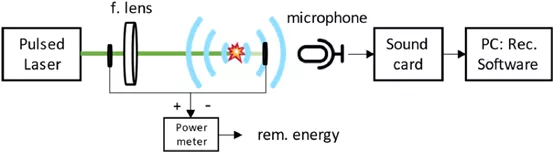
This research focuses on the systematic study of Laser-Plasma Sound Sources (LPSS), generated via Laser-Induced Breakdown (LIB) of atmospheric air by intense laser pulses (ns and fs). We investigate the fundamental relationship between the optical radiation characteristics (energy, wavelength, focusing) and the resulting acoustic emission (energy, spectrum, directivity). We develop theoretical models linking the plasma's thermal radiation to the generated sound wave and models for the directivity of filamentary sources, aiming at controlling and optimizing these sources for applications in acoustic metrology, sound reproduction, and biomedicine.
Laser-Plasma Sound SourcesLaser-Induced BreakdownAcoustic N-pulsesAcoustic DirectivityFilamentary Sources
Overview
Sound generation by laser beams is a fascinating phenomenon with rapidly growing research and technological interest. LPSS offer unique advantages over conventional electromechanical or piezoelectric sources: they are massless, point-like or line-like, generate broadband pulses (from infrasound to ultrasound), and can be positioned anywhere without physical intrusion.
Our research focuses on understanding and controlling these sources through an integrated experimental and theoretical approach:
Systematic Experimental Study:
-
- We conduct extensive measurements of LPSS acoustic emission generated by ns (532 nm, 1064 nm) and fs (800 nm) pulses under various energy and focusing conditions.
- We record far-field sound pressure and analyze the dependence of total acoustic energy, peak pressure, and frequency spectrum on laser characteristics.
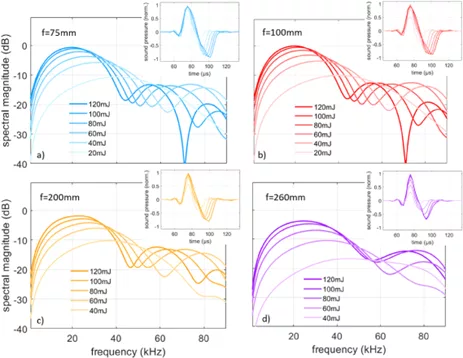
- Key Findings: Increasing ns pulse energy leads to increased acoustic energy and a spectral shift towards lower frequencies. For fs pulses, acoustic energy extends well beyond the audible range, while directivity critically depends on plasma geometry (filamentary sources).
Correlation of Light and Sound:
-
- We develop an innovative methodology for simultaneous recording of light and sound signals.
- Thermal radiation corresponds to the heat evolution in the interaction volume, which is the direct cause of thermoelastic expansion and sound wave generation.
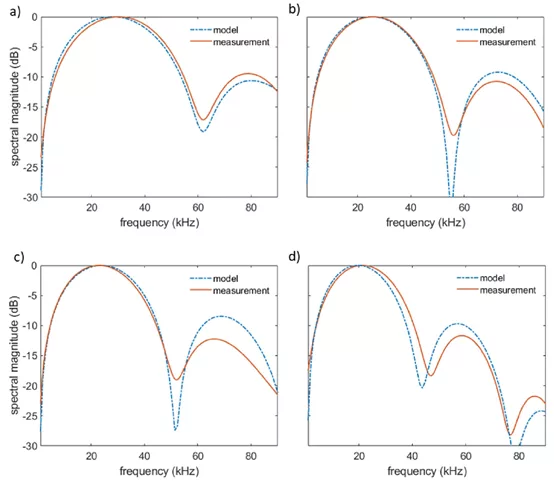
- Theoretical Model: We use the thermal signal as a source (heat term) in the wave equation to calculate the spectrum of the generated sound pulse. The model results show excellent agreement with experimental measurements, demonstrating the direct correlation between light and sound radiation.
Modelling Acoustic Directivity of Filamentary Sources:
-
- We study the acoustic behaviour of filamentary sources generated by loosely focused fs pulses.
- We develop an acoustic model simulating the filament as a finite-length line source, composed of elementary N-pulse point sources. The pressure distribution along the filament is derived from plasma luminescence (optical imaging).
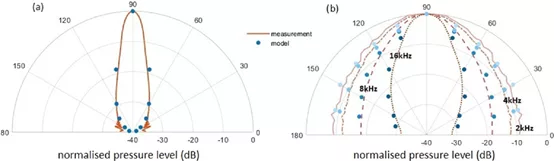
- The model accurately predicts source directivity, which is maximum perpendicular to the filament axis and becomes more pronounced at higher frequencies. This work provides a powerful tool for designing directional acoustic sources with controlled characteristics.
Examples
Acoustic Spectra for ns Pulses. Graphs comparing the sound spectra for various ns pulse energies (20-120 mJ) and focal lengths
Correlation of Light and Sound. Comparison of the experimental sound spectrum with the spectrum calculated by the model using the thermal signal.
Acoustic Directivity of a Filament. Polar plot comparing the experimental and calculated directivity of a filamentary source for different frequency bands (2 kHz, 4 kHz, 8 kHz, 16 kHz).
Publications
Kaleris, K., Orphanos, Y., Petrakis, S., Bakarezos, M., Tatarakis, M., Mourjopoulos, J., Papadogiannis, N.A. (2024). Laser-plasma sound sources in atmospheric air: A systematic experimental study. Journal of Sound and Vibration, 570, 118000. https://doi.org/10.1016/j.jsv.2023.118000
Delibašić Marković, H., Kaleris, K., Papadogiannis, N.A., Petrović, V. (2024). Comparative analytical and numerical investigation of the plasma density in atmospheric air generated by nanosecond laser pulses. Laser Physics Letters, 21(3), 033001. https://doi.org/10.1088/1612-202X/ad1cd9
Kaleris, K., Tazes, I., Orphanos, Y., Petrakis, S., Bakarezos, M., Mourjopoulos, J., Dimitriou, V., Tatarakis, M., Papadogiannis, N.A. (2021). Experimentally validated modeling of the optical energy deposition in highly ionized ambient air by strong femtosecond laser pulses. The European Physical Journal D, 75, 236. https://doi.org/10.1140/epjd/s10053-021-00237-x
Kaleris, K., Orfanos, Y., Bakarezos, M., Dimitriou, V., Tatarakis, M., Mourjopoulos, J., Papadogiannis, N.A. (2020). On the correlation of light and sound radiation following laser-induced breakdown in air. Journal of Physics D: Applied Physics, 53(43), 435207. https://doi.org/10.1088/1361-6463/ab9ee6
Kaleris, K., Orfanos, Y., Bakarezos, M., Papadogiannis, N., Mourjopoulos, J. (2019). Experimental and analytical evaluation of the acoustic radiation of femtosecond laser plasma filament sound sources in air. JASA Express Letters, 146(3), EL212-EL218. https://doi.org/10.1121/1.5124509