
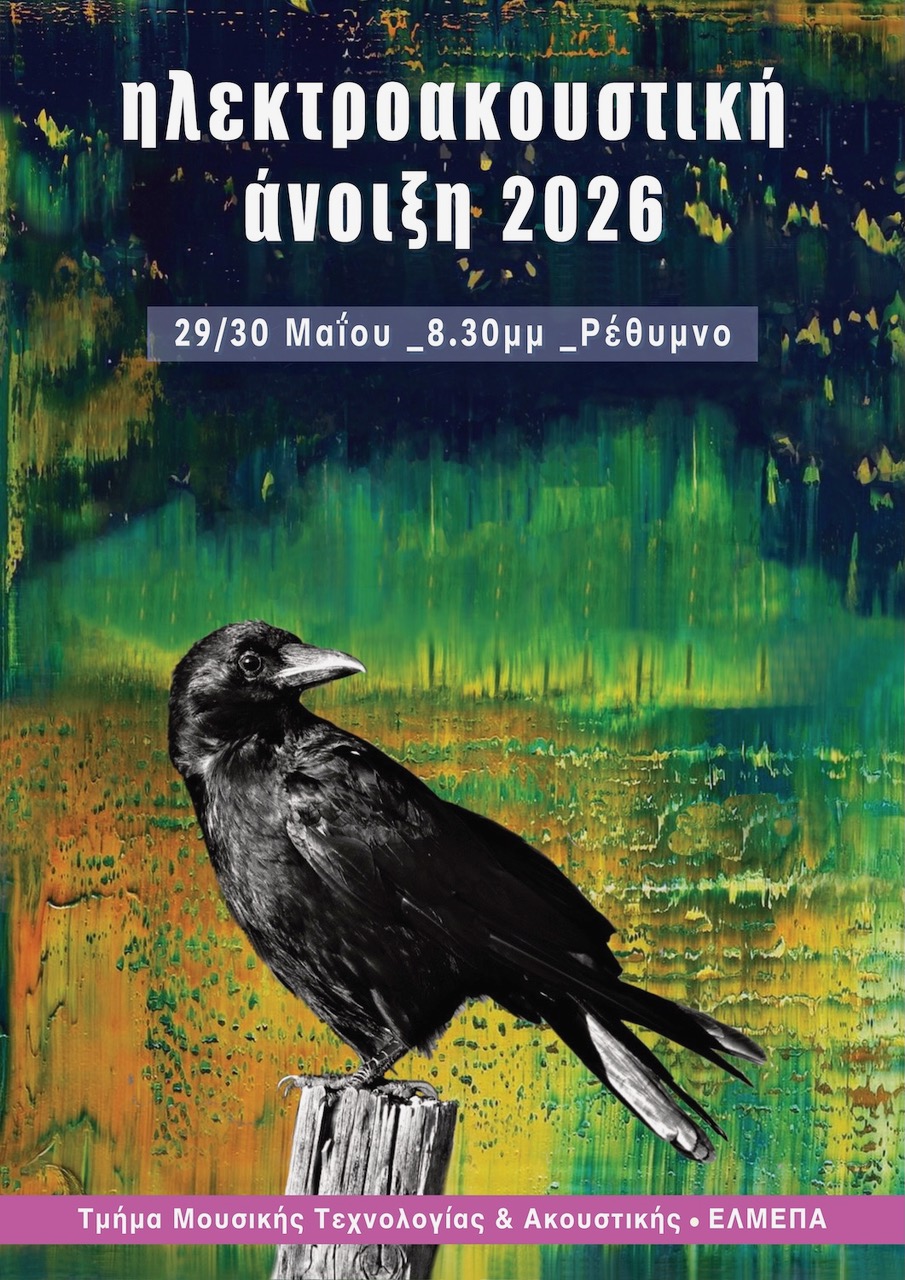
Electroacoustic Spring 2026
29 & 30 May, 8.30 pm.
Auditorium of the Department of Music Technology & Acoustics (HMU), Rethymno
Electroacoustic Spring is the annual (since 2014) electroacoustic music festival in Rethymno, Crete. The program includes compositions from various trends in electroacoustic / acousmatic music where recent and older works of the international repertoire are presented. The works are played with a loudspeaker orchestra around the audience.
Electroacoustic Spring 2026 presents a special tribute to Andreas Mniestris, a concert dedicated to the Belgian Federation for Electroacoustic Music (FeBeMe) along with works by members of CIME/ICEM and HELMCA/ΕΣΣΗΜ. This year the program includes works by Andreas Mniestris, Bruno Abt, Roelandt Luyten, Victor Outters, Sophie Delafontaine, Dirk Veulemans, Edmar Soria, Mario Mary, Jon Christopher Nelson, John Young, João Pedro Oliveira, Stelios Zoumadakis, Spyros Polychronopoulos, Dimitris Barnias, Nikolas Valsamakis amd Katerina Tzedaki.
Festival organisation: Nikolas Valsamakis & Katerina Tzedaki
Friday 29 May
Concert A1
Edmar Soria – Post Anthropocene Record No. X.01 (2025) 10:17 [8 channel]
Mario Mary – Pedro en su Laberinto (2023) 10:10 [8 channel]
Jon Christopher Nelson – Toward the Event Horizon (2022) 09:01
John Young – Le Chant en Dehors (2022) 10:07 [8 channel]
João Pedro Oliveira – Pulses (2025) 08:54 [8 channel]
Concert A2
Bruno Abt – Keramikos – Rituel de l’Air (2024) 11:35 [8 channel]
Roelandt Luyten – Viscosités (2024)10:02 [8 channel]
Victor Outters – Pour lui prendre sa bague, ils lui ont cisaillé le doigt (2021) 09:30
Sophie Delafontaine – Bouffée (2024) 14:00
Dirk Veulemans – De Zandman (2007/2025) 09:54 [8 channel]
Saturday 30 May
Concert B1
Stelios Zoumadakis – Alien Signals from my Freezer (2026) 07:11
Spyros Polychronopoulos – Feeling of Movement (2011) 04:41
Marta Domingues – A Cathartic Postcard (2024) 09:36 [8 channel]
Dimitris Barnias – A Handful of Nothing (2026) 07:28 [4 channel]
Nikolas Valsamakis – SpinDec (2026) 08:40 [8 channel]
Katerina Tzedaki – ANS (2026) 13:00 [8 channel]
Concert B2
Andreas Mniestris – Maghradya (1986-87) 06:11
Andreas Mniestris, Simona Sarchi – IInvisible Cities, Part I (1999/2007) 30:38 [6 channel]
Andreas Mniestris – Free Associations: Jungle (2017) 03:45
Andreas Mniestris, Simona Sarchi – Naturae/Continua – Part II (2023) 09:43 [8 channel]
________________________________________________________________
Concert A1
Edmar Soria – Post Anthropocene Record No. X.01 (2025) 10:17 [8 channel]
In 1950, Alan Turing published his famous article entitled “Computing machinery and intelligence” in which, among other things, he proposed the so-called “imitation game” in order to establish a type of heuristic with which it would be possible to know whether or not a machine exhibits intelligent behavior. The article begins with the powerful and forceful question: can a machine think? A little more than 70 years later and after the long road travelled in the study and development of artificial intelligence systems, a new question is proposed here: Can a machine dream? In that sense, this acousmatic work represents (from a speculative point of view) the experiential record of the first machine that was able to dream, some time ahead in a unknown future. And so, this works place us at the first person´s perspective of its first dream.
Mario Mary – Pedro en su Laberinto (2023) 10:10 [8 channel]
This composition is a proposal with a high density of sound materials and few breaths. The work displays an indefatigable energy through an articulate and vital polyphonic discourse. The multiple trajectories and sound planes generate a rich and changing acoustic space around the listener. All this complexity could be linked to life itself, in which, without realizing it, we progressively create our own labyrinths and the terrains where our deepest joys and conflicts develop.
Jon Christopher Nelson – Toward the Event Horizon (2022) 09:01
Toward the Event Horizon conceptualizes what might transpire as sound waves approach the event horizon of a black hole, where time slows down and a sound’s very existence becomes stretched beyond recognition. In this work, spectral elements of sounds are temporally and registrally manipulated, disintegrated and reconstituted. The resulting soundscape attempts to create a sense of slow and massive sounds that are wrenched apart. While arguably there is no sound in the vacuum of space, NASA scientists have noted that the black hole at the center of the Perseus galaxy releases pressure waves that cause subsonic ripples in the cluster’s hot gas. While nearing the completion of this movement, NASA released an audio sonification of these black hole pressure waves. NASA’s sonification is included in the final moments of this composition. This work constitutes one of six movements of the larger work, The Persistence of Time and Memory.
John Young – Le Chant en Dehors (2022) 10:07 [8 channel]
Le Chant en Dehors creates an atmosphere of evolving connection between sonorities of definite and indefinite pitch, or ‘tone’ and ‘noise.’ The title is taken from an instruction used by the French composer Francis Poulenc, meaning ‘bring out the tune.’ That idea is reflected in this work whereby strands of pitch — as resonance or attack morphologies — coalesce to imply states of linear or spectral connectedness as emergent melodic or harmonic strands. The spatial setting of the work exploits ways in which noise-based material tends to be more active within the three-dimensional frame than focally pitched / resonant sounds. In Le chant en dehors these contrasting types of sonority are placed in changing patterns of interaction to evoke waves of tension and release.
João Pedro Oliveira – Pulses (2025) 08:54 [8 channel]
Pulses is an acousmatic piece based on the iteration of different pulses, in many different contexts, and transformations.
Concert A2
Bruno Abt – Keramikos – Rituel de l’Air (2024) 11:35 [8 channel]
Electroacoustic piece in several movements, composed and spatialised in 8 tracks or in stereophony, from the transformed recordings of the ceramic sounds produced by Aude de Vinck (daughter of Antoine de Vinck), Alice de Vinck (wife of Antoine de Vinck), Bruno Abt, and Dominique Lion, a potter in Puisaye. ‘Born of earth and water, by air and fire, the ceramic object is perceived as holistic, as part of the whole world. All primitive ceramics, even utilitarian ones, have this cosmic, and therefore sacred, character. Forms and decorations contribute to making them microcosms, that is to say objects of art, objects charged with potentialities, with meanings. (…)’ Antoine de Vinck. The piece was created as a ritual invoking a ceramic god, Keramikos, imagined by the composer. It unfolds in the time and sound space of the 8 eight loudspeakers, making audible a composed and organised counterpoint of transformed sounds, from the recordings of the various stages of the creation of the ceramic object: preparation of the raw earth, turning, glazing, firing, unloading… In this musical composition, the ceramicist is seen as a mage who, by invoking the god, joins with him to shape the ceramic through the four elements. One should not look for a literal illustration of the creative process, consisting of a systematic recognition of the raw sounds of the workshop, ordered chronologically, but rather as a symbolic interpretation of this process through a musical journey to the heart of the material. Most of the sounds captured with the microphone were transformed in the studio, as in an alchemical laboratory of sound – and this in resonance with the transformation of the earth and the glazes which, through the gestures of modelling, rubbing and firing, become the ceramic object. The piece is is originally composed of two parts :
Ritual of the Air – Turning – Shaping – 11’35
The Chamber of Fire – Firing – Eutectic – 7’46
Ritual of the Air – Turning – Shaping. This section develops a musical texture woven from the various transformations of the recordings of mechanical and electric turning – the sound of the motor, of the rotation, the rubbing of the ceramicist’s utensils, the gestures of the turning – by the ceramicist Dominique Lion. The whole forms an incantatory chant evolving by gradation, punctuated by the percussion of the recordings of the beating of the earth. Evolving through the hypnotic movement of the rotation, the texture reaches a final section in which we can hear excerpts from an interview with Antoine de Vinck, whose words are interwoven with the music in a vibrant counterpoint.
Roelandt Luyten – Viscosités (2024)10:02 [8 channel]
Viscosités is an electroacoustic composition that explores auditory density through the interaction and fusion of sound textures. As the second part of a cycle inspired by states of matter, the work takes its inspiration from the physical property of viscosity—the resistance of a fluid to flow or deformation—translating this concept into the sonic domain. Sound is treated as matter whose internal density and resistance can shift continuously, creating impressions of fluidity, thickness, and suspension. The piece emphasizes timbre, texture, and gradual transformation. Different layers of sound interact much like molecules in varying states of matter, alternately flowing freely, slowing, colliding, or coagulating into denser forms. These interactions define the musical structure, allowing the listener to perceive changes in pressure, weight, and motion through sound alone. Through processes of layering, filtering, spectral shaping, and spatial control, sonic materials are shaped to continuously shift between transparency and opacity. Subtle changes in density alter how sounds merge or resist one another, creating a dynamic balance between movement and inertia. Viscosités invites a focused listening to the behavior of sound as fluid matter, revealing how minute changes at the micro level can reshape the perception of the overall sonic field. The piece was produced at the Musiques & Recherches studio in March 2024.
Victor Outters – Pour lui prendre sa bague, ils lui ont cisaillé le doigt (2021) 09:30
Each scar has a story behind it. Between the moment of injury and the wounds finally closed, long processes take place. Behind this title (meaning in English, “to take their ring, they cut off their finger”) lies a study on the theme of suturing, infection, rejection, or more generally, the struggle to adapt to the unforeseen.
Sophie Delafontaine – Bouffée (2024) 14:00
Bouffée draws its inspiration from an intense personal experience: that of giving birth. Through this composition, I sought to translate into sound the sensations of contractions, held breath, concentration, and the trance-like state that accompanies such an event. The core of the sonic material is based on the sounds of the Babel Table. The Babel Table is an original instrument created by Jean-François Laporte (Productions Totem Contemporain, Montreal). He invites artists to compose for his singular creations, and it was in this context that he welcomed me for a composition residency in Montreal. The original mixed version of Bouffée was premiered on November 2, 2023. In 2024, I undertook a reworking of the piece into a purely acousmatic version. Powered by an air compressor, the Babel Table sends air through various tubes and membranes. This makes it possible to produce (among other things) continuous sounds, similar to those of an organ or bagpipe. The duration of the sound is not limited by human breath. These unique sonic qualities were essential in helping me convey my sensations during childbirth. The sustained continuity of certain sounds blurs the listener’s sense of time. This loss of temporal reference reflects my own experience during labor, when minutes seemed to stretch out or disappear entirely. Despite the intense and sometimes noisy moments that shape the piece, I perceive a hidden softness within this music, and I hope that you will be able to perceive it as well.
Dirk Veulemans – De Zandman (2007/2025) 09:54 [8 channel]
For centuries, humans have felt the urge to recreate themselves. To construct an image that resembles themselves as closely as possible. In 2007, the theatre collective In Vitro (with Jan Dekeyser and Dafne Kitschen) explored this theme in a theatre production based on the 19th-century tale *Der Sandmann* by E.T.A. Hoffmann, a writer of fantastical and bizarre stories. In Hoffmann’s Der Sandmann, there is a deep connection between, on the one hand, the childish fear of the Sandman who sprinkles sand into children’s eyes and then abducts them, and, on the other hand, Nathanael’s, the central figure, obsessive infatuation with a female mechanical automaton that seems enlivened by artificial eyes. A 19th-century precursor to our current obsession with AI. Both motifs revolve around the eye as an element of perception, illusion and vulnerability. Together, they lead to Nathanael’s madness and downfall. The play employed 19th-century imagery in a contemporary manner. The same applies to the soundscape in this composition, which could be heard in 8-channel surround sound at the climax of the performance.
Concert B1
Stelios Zoumadakis – Alien Signals from my Freezer (2026) 07:11
The track was written between February and March 2026. Most of the sounds come from my refrigerator’s freezer.
Spyros Polychronopoulos – Feeling of Movement (2011) 04:41
All the instruments (piano, guitar, drums, double bass, cello, clarinet, bass clarinet and electric bass), heard on this album, were recorded in different rooms or studios. The main idea was to achieve a strange “feeling of movement” in space and time by listening this outright transition from one room to another. We are used to viewing and listening to this conversion in the movies when one scene flashes after another. If the first scene is in a small room and the other is in a big one, we know that we moved to a larger place firstly by viewing it on screen and then by hearing it through the speakers. In the real world, even if our eyes are closed, we can understand the size of the room we are in by its reverb, whereas it is not feasible to hear instant reverb transitions. So the goal on this album was to achieve this effect only by sound. The “movement” from one room to another gives me the “feeling” that the music moves through space as well as through time. When we listen to music we think of time as a necessary and linear variable, but as I was experimenting on mixing these different spaces and the instant transition from one to another, I got a strange sense of time as a non linear variable as the track was evolving over time.
Marta Domingues – A Cathartic Postcard (2024) 09:36 [8 channel]
To write this piece, I asked percussionist Francisco Cipriano to record a free improvisation, without musical guidelines or which instruments to use. The challenge I set myself was to work solely with this sound material and create a piece with no other sounds except his. The search to re-combine and recompose the sound world I was given resulted in a cathartic musical postcard, from me to the listener.
Dimitris Barnias – A Handful of Nothing (2026) 07:28 [4 channel]
Fragments of sound and speech from the world of John Cage, as described in his text ‘A Lecture on Nothing’. Algorithmically designed, with selective key points assistance from the composer.
Nikolas Valsamakis – SpinDec (2026) 08:40 [8 channel]
SpinDec (2026) is a micro-sound composition for 8 channels. Εxplores the lifecycle of sonic particles: attacks, spins, spatial dances, collisions, decays, and transformations. Particular focus is given to the concept of decay in events. While in audio decay describes the rate at which a sound’s volume decreases, in particle physics the term has a special meaning: decay refers to the spontaneous process through which an unstable subatomic particle transforms into multiple other particles. All audio material has been produced through a personally designed, non-standard algorithmic procedure for direct waveform computation and the synthesis of sonic microforms. Musical phrases have been constructed through micro-montage and extended granular transformations.
Katerina Tzedaki – ANS (2026) 13:00 [8 channel]
The main idea of this composition is of a universe that vibrates, flickers and folds creating spaces. It is based on improvisations using Virtual ANS software both in computer and phone.
Concert B2
Andreas Mniestris – Maghradya (1986-87) 06:11
Μαγράδια τοις ρυϊνίοις επέρρωγον (Maghradya tis ryeeneeice eperogon): this nonsensical homeric-like phrase has settled itself arbitrarily as the title of my first piece for tape, immediately after its completion at the GES-Vierzon studio, in the city of Vierzon in central France, in April 1987. I have occasionally written in various concert notes that this piece is: “a hymn to the second law of thermodynamics”, “a bitter protest”, “a song concrète” (if it is ever possible!), “an exercise in the techniques of music for tape” and many others. They are all true. The sparse words heard here-and-there had been written long time before this piece by Panagis Bicoulas. On the technical level, this piece has several imperfections, quite naturally –since it is an early study. Although imperfect or perhaps because of this, the piece shows an unpretentious spontaneity that I still enjoy. Thus, when I was asked to include it to this program I gladly accepted.
Andreas Mniestris, Simona Sarchi – IInvisible Cities, Part I (1999/2007) 30:38 [6 channel]
In 1999, an exhibition was held in Corfu featuring images printed on fabric, in the manner of Buddhist thangkas. These images resulted from the digital processing of selected photographs taken during photographic reportages carried out during the 1980s by Simona and Giorgio Bondi in Syria, India, Yemen, Egypt, and elsewhere. Influenced, to varying degrees, by Invisible Cities by Italo Calvino, the collection of these processed images was conceived as an imaginary landscapes through which the visitor might wander whithin the exhibition space.
For this pace, I had organised a sound installation, using environmental sounds, various sonic objects, excerpts from recordings by Munir Bashir, Bismillah Khan, Rabih Abou-Khalil, Anouar Brahem, Belfast Harp Orchestra, Ali Akbar Khan, Hussein El Asry, Muhamad Qadri Dalal, Nusrat Fateh Ali Khan and Muddy Waters as well as folk and religious music from India, Liberia, and Ethiopia. My aim was to create a non-realistic sonic environment that, on the one hand, is constantly changing without ever repeating itself, and on the other hand remains as unobtrusive as our everyday sonic environment—so that it can accompany visitors as they wander among the images installed in the exhibition space. The video is based on the images and sounds of that exhibition and proposes a similar imaginary journey, except that now the images and sounds are in motion, while the viewers/listeners remain still, observing. Today, many of the places appearing in these images no longer exist. After relentless bombings and extreme violence, they have been destroyed, and the people who lived there have been forced into exile. We live in times in which political correctness and raw violence coexist harmoniously, while at the same moment human communities and the natural environment are mercilessly destroyed in live broadcast on television and the internet. From that perspective, this work takes on an unexpected, harrowing, relevance.
photography: Simona Sarchi, Giorgio Bondi image and video processing: Simona Sarchi
electroacoustic music composition: Andreas Mniestris
Andreas Mniestris – Free Associations: Jungle (2017) 03:45
This piece is a furtive glimpse-through-the-keyhole into a work of a much longer duration entitled Free Associations. The Jungle, a small fragment of it, was completed during a collaboration with the Music, Technology and Innovation (MTI) Department of De Montfort University in Leicester, England. It was the result of the intensive testing of an application called Composing With Sounds, specifically designed for secondary-school students as a tool for learning electroacoustic music composition methods by working directly with the sonic material. Special thanks are due to Professor Leigh Landy, Head of Research of the department (at that time), who conceived and oversaw this project. The context as well as the sonic material of the Jungle is based on Kostas Varnalis’ voice reciting excerpts of his poems and particularly the very famous « The Doomed » , whose anonymous characters’ “the mind, though be racked with torment, in memory not a single bright day rises…”. I hear this piece as a part of the soundscape of the ongoing recession and depression that has afflicted this country (at least) since 2010, echoing the eternal despair of Varnalis’s doomed figures. At the end, the poet asks us: “Who is to blame?… Who is to blame?”…well, who indeed !
Andreas Mniestris, Simona Sarchi – Naturae/Continua – Part II (2023) 09:43 [8 channel]
Naturae/Continua is the provisional title of a three-part audiovisual work in progress (ibid.). Presented here is its second part. The work relates loosely to a text translated by Thomas Henry Huxley and published as “Nature: Aphorisms by Goethe” in the first issue of Nature (Vol. 1, No. 1, 4 November 1869): «Nature! We are surrounded and embraced by her: powerless to separate ourselves from her, and powerless to penetrate beyond her. Without asking, or warning, she snatches us up into her circling dance, and whirls us on until we are tired, and drop from her arms. She is ever shaping new forms: what is, has never yet been; what has been, comes not again. Everything is new, and yet nought but the old. We live in her midst and know her not. She is incessantly speaking to us, but betrays not her secret. We constantly act upon her, and yet have no power over her.» This work was first presented here in Rethymno in November 2023, during the Electroacoustic Music Days 2023 festival.
photography, image and video processing: Simona Sarchi
electroacoustic music composition: Andreas Mniestris