
Acoustically Driven Crystalline Undulators (A-CUs) for the generation of intense and monochromatic gamma rays
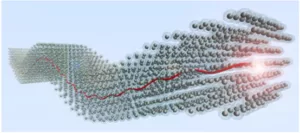 This research focuses on developing a novel technology for generating tunable, directional, and narrowband gamma (γ) radiation using high-frequency acoustic waves (10-40 MHz) in silicon monocrystals. The acoustic waves, generated by piezoelectric transducers, induce a periodic bending of the crystal planes. When an ultra-relativistic positron beam (e.g., 20 GeV) traverses the crystal at a specific angle, it becomes “trapped” in the crystal channels and is forced to follow a wiggly trajectory, emitting γ radiation. The radiation’s frequency and intensity are dynamically controlled via the acoustic wave’s frequency and amplitude. This technology is being developed under the TECHNO-CLS project (Horizon Europe EIC Pathfinder) and has been recognized by the European Commission’s Innovation Radar as a high-potential innovation for applications in fundamental research, nuclear technology, and medicine.
Acoustic WavesUltra-Relativistic PositronsGamma RadiationCrystalline UndulatorsFinite Element Method
Overview
The production of gamma (γ) radiation with controlled characteristics (narrow bandwidth, tunable energy, directionality) is a major challenge in modern physics, with immense application potential in fields such as nuclear physics, medical imaging and therapy, and materials science. Existing technologies (e.g., synchrotrons, pulsed sources, radioactive isotopes) have significant limitations in cost, size, tunability, and spectral purity.
Our research team is developing a revolutionary approach: Acoustically Driven Crystalline Undulators (A-CUs). This technology combines acoustics, materials science, and high-energy physics.
Operating Principle:
- Acoustic Wave Generation: A piezoelectric transducer is bonded to a high-purity silicon (Si) monocrystal. By driving the transducer at a suitable frequency (e.g., 10-40 MHz), a longitudinal acoustic wave is generated and propagates along the crystal. Absorbing materials at the opposite end ensure the wave is traveling, not standing.
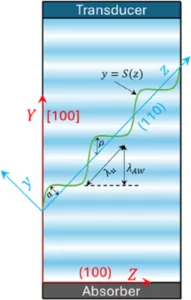
- Periodic Lattice Deformation: The acoustic wave induces periodic compressions and rarefactions of the crystal lattice. This results in the periodic bending of the crystal planes (e.g., (110) planes), with amplitude a and period λᵤ. The period λᵤ is directly related to the acoustic wavelength.
- Positron Channeling: An ultra-relativistic positron beam (e.g., 20 GeV, available at CERN) enters the crystal at a 45° angle, propagating along the (110) planes. The positrons become “trapped” in the channels formed between the planes due to the strong electric fields.
- Radiation Emission: Following the wiggly path of the bent planes, the positrons undergo acceleration and emit radiation (Crystalline Undulator Radiation – CUR). The energy of the γ-photons is determined by the positron energy, the bending period λᵤ (controlled by the acoustic frequency), and the bending amplitude a (controlled by the acoustic power). This technology promises radiation generation from the keV to MeV range, with potential extension to the GeV range.
Methodology:
- Computational Modelling & Simulation:
-
-
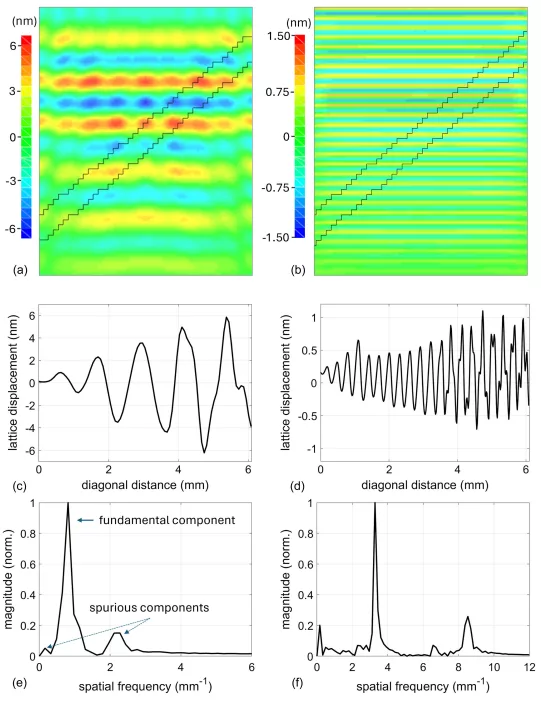
- FEM (LS-DYNA):We develop detailed 3D finite element models to simulate acoustic wave propagation inside the Si crystal. We calculate the induced lattice displacement and the resulting bending profiles of the (110) planes for various frequencies (10 MHz, 40 MHz).
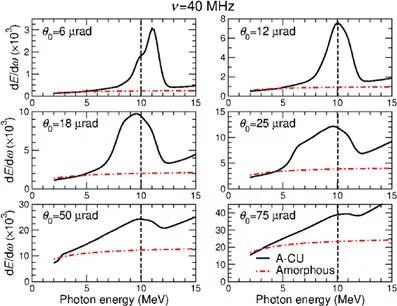
- Relativistic Molecular Dynamics (MBN Explorer):The bending profiles from FEM are used as input for Rel-MD simulations, where the trajectories of thousands of positrons within the deformed crystal are calculated. From these trajectories, the spectral distribution of the emitted γ radiation is computed. Results show a significant enhancement of radiation within narrow spectral bands around 2 MeV (for 10 MHz) and 10 MeV (for 40 MHz), confirming the device’s functionality.
-
-
- Experimental Characterization:
-
-
- Prototype Development: A-CU prototypes using 1 mm thick Si crystals and 10 & 20 MHz piezoelectric transducers.
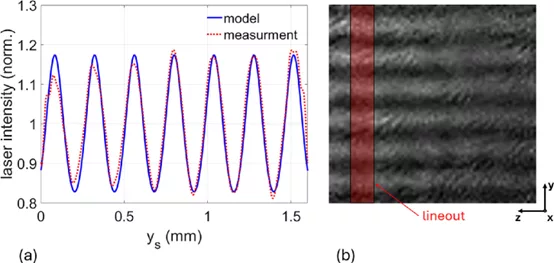
- Fast Laser Refraction Imaging (FLRI):We develop a high-precision optical method to directly characterize the acoustic field inside the crystal. A ns laser pulse passes through the crystal. The periodic change in refractive index due to the acoustic wave causes beam refraction, creating a characteristic intensity distribution on a camera. By analyzing this distribution with a specially developed computational model, we accurately determine the pressure, wavelength, and harmonicity of the acoustic field.
-
-
Innovation & Impact (based on Innovation Radar):
This technology, developed within the TECHNO-CLS project, has been recognized by the European Commission’s Innovation Radar. It is characterized by:
-
-
-
- Market Creation Potential:It addresses needs in existing markets (fundamental research, nuclear technology, medicine).
- Sustainable Development Goals (SDG):It contributes to SDG 7 (Energy) and SDG 9 (Industry, Innovation).
- Next Steps:Preparation for market entry and scaling up opportunities.
-
-
Examples
A-CU Schematic
FEM Simulation of Acoustic Deformation: Displacement maps of the Si crystal for 10 MHz and 40 MHz excitation, the corresponding bending profiles, and FFT spectra.
Radiation Spectrum: Calculated radiation spectra for 40 MHz.
Experimental Characterization: Experimental laser intensity distribution due to refraction from the acoustic wave, compared to the computational model.
Publications – Projects
Kaleris, K., Kaselouris, E., Dimitriou, V., Kaniolakis-Kaloudis, E., Bakarezos, M., Tatarakis, M., Papadogiannis, N.A., Sushko, G.B., Korol, A.V., Solov’yov, A.V. (2025). Narrowband γ-ray radiation generation by acoustically driven crystalline undulators. Phys. Rev. Accel. Beams, 28, 033502. https://doi.org/10.1103/PhysRevAccelBeams.28.033502
Kaniolakis-Kaloudis, E., Papadogiannis, N.A., Orphanos, Y., Bakarezos, M., Kaleris, K. (2025). Precise control of high-frequency ultrasounds in thin crystals for the development of tunable narrowband and directional γ-ray sources. J. Acoust. Soc. Am., 158(6), 4007-4016. https://doi.org/10.1121/10.0039880
TECHNO-CLS (Horizon Europe EIC Pathfinder Open, G.A. 101046458). https://mbnresearch.com/TECHNO-CLS/Main
Innovation Radar: “Acoustic Wave Crystalline Undulators for tunable γ-ray generation”. https://innovation-radar.ec.europa.eu/innovation/63722
Innovation Radar: “Nanosecond laser interferometer system and phase imaging technology for characterization of CLS based on travelling acoustic waves”. https://innovation-radar.ec.europa.eu/innovation/63723
Research Team
Nektarios A. Papadogiannis, Professor
Michael Tatarakis, Professor
Vasilis Dimitriou, Professor
Makis Bakarezos, Professor
Evaggelos Kaselouris, Assistant Professor
Yannis Orphanos, Laboratory Teaching Staff
Konstantinos Kaleris, Postdoctoral researcher
Emmanouil Kaniolakis-Kaloudis, PhD Candidate