
Vibroacoustic Analysis and Design Optimization of String Musical Instruments
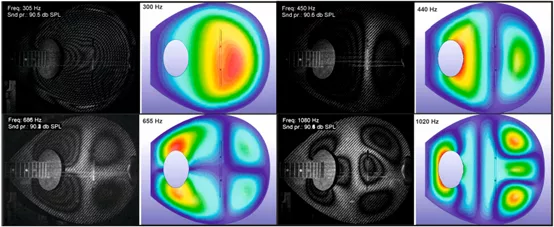
This research focuses on studying the vibrational and acoustic characteristics of string instruments. Through an interdisciplinary approach combining Finite Element Method (FEM) simulations, experimental measurements (ESPI, FRF), psychoacoustic evaluation, and machine learning, we aim to understand how design parameters (materials, geometry, thickness) influence the produced sound. The ultimate goal is the optimization and construction of instruments using modern materials (carbon fiber, 3D printed polymers).
Finite Element MethodElectronic Speckle Pattern Interferometry3D PrintingCarbon FiberMachine Learning
Overview
Traditional musical instrument construction relies on wood, a material with unique acoustic properties but also significant drawbacks: sensitivity to humidity and temperature, scarcity of certain species, and environmental impact. Our research group investigates the possibility of replacing or combining wood with modern materials, such as carbon fiber and 3D printing polymers (e.g., PETG), while maintaining or even improving the acoustic characteristics of traditional instruments.
To achieve this, we have developed an integrated methodology comprising:
- Experimental methods: We utilize:
-
-
- Electronic Speckle Pattern Interferometry (ESPI): An optical technique that visualizes the vibration mode shapes on the instrument’s surface with nanometer accuracy.
- FRF (Frequency Response Function) Measurements: Using the roving hammer method and accelerometers, we capture the instrument’s response across a frequency range.
-
-
- Modeling and Simulation: We create high-precision 3D CAD models (often via 3D scanning) and perform Finite Element Method (FEM) simulations using software like LS-DYNA. These simulations calculate the mode shapes, eigenfrequencies, and acoustic response of the instruments.
- Psychoacoustic Evaluation: To link physical measurements with human perception, we conduct psychoacoustic experiments. Musicians and listeners evaluate the sound and playability of the instruments, rating parameters such as “warmth,” “brilliance,” “balance,” and “ease of play.”
- Machine Learning for Optimization: The collected data (simulations, measurements, psychoacoustics) are used to train machine learning models. The goal is to create models that can predict the acoustic characteristics of an instrument based on its design parameters (e.g., soundboard thickness, material type, string tension) and, conversely, to suggest optimal parameters for achieving a desired timbre.
This methodology has been successfully applied to study a carbon fiber bouzouki (compared to a traditional wooden one), investigate 3D printed top plates for the tzouras, and analyze cymbals and membranes. Results indicate that modern materials can approach, and in some cases enhance, specific acoustic characteristics, opening new avenues in instrument making.
Examples
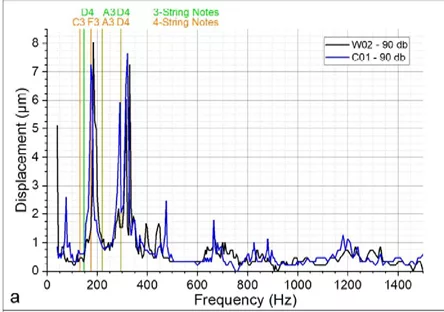
Carbon Fiber Bouzouki: Comparison of the vibrational behavior of a carbon fiber bouzouki (C01) with a traditional wooden one (W02) using ESPI measurements showed similar behavior.
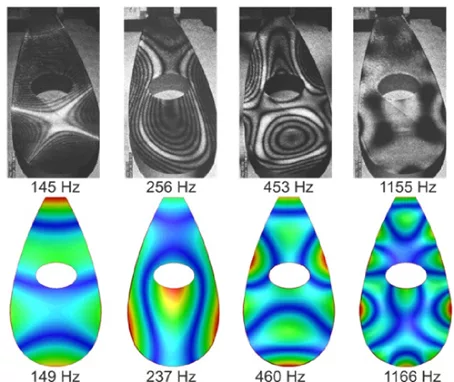
Mode Visualization: Characteristic images from ESPI measurements show the vibration shapes of a PETG top plate, in excellent agreement with FEM simulation results.
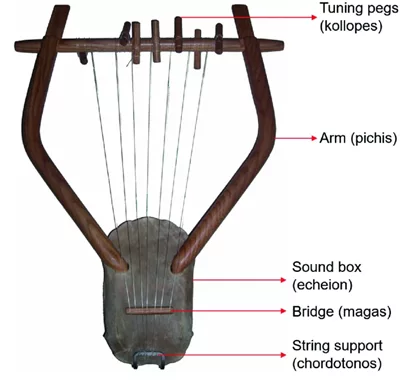
Reconstruction of the ancient Greek lyra Chelys.
Publications
Brezas, S., Papadaki H., Katsipis, M., Grigoriou, D. et al. (2024). Investigation of the vibrational characteristics of tzouras 3D printed top plates. Materials Research Proceedings, Vol. 46, pp 82-89. https://doi.org/10.21741/9781644903377-11
Brezas, S., Katsipis, M., Kaleris, K., Papadaki, H., Katerelos, D.T.G., Papadogiannis, N.A., Bakarezos, M., Dimitriou, V., Kaselouris, E. (2024). Review of Manufacturing Processes and Vibro-Acoustic Assessments of Composite and Alternative Materials for Musical Instruments. Applied Sciences, 14(6), 2293. https://doi.org/10.3390/app14062293
Brezas, S., Katsipis, M., Orphanos, Y., et al. (2023). An Integrated Method for the Vibroacoustic Evaluation of a Carbon Fiber Bouzouki. Applied Sciences, 13(7), 4585. https://doi.org/10.3390/app13074585
Kaselouris, E., Dimitriou, V. (2023). Vibro-acoustics time domain FEM-BEM analysis of a Titian Stradivari violin: the role of the bridge. Journal of Physics: Conference Series, 2458, 012009. https://doi.org/10.1088/1742-6596/2458/1/012009
Kaselouris, E., Bakarezos, M., Tatarakis, M., Papadogiannis, N.A., Dimitriou, V. (2022). A Review of Finite Element Studies in String Musical Instruments. Acoustics, 4(1), 183-202. https://doi.org/10.3390/acoustics4010012
Kaselouris, E., Orphanos, Y., Bakarezos, M., Tatarakis, M., Papadogiannis, N.A., Dimitriou, V. (2021). Influence of the plate thickness and material properties on the violin top plate modes. INTER-NOISE and NOISE-CON Congress and Conference Proceedings, InterNoise21, Washington, D.C., USA, pp. 3369-3377. https://doi.org/10.3397/IN-2021-2387
Bakarezos, E., Orphanos, Y., Kaselouris, E., Dimitriou, V., Tatarakis, M., Papadogiannis, N.A. (2019). Laser-Based Interferometric Techniques for the Study of Musical Instruments. In: Bader, R. (eds) Computational Phonogram Archiving. Current Research in Systematic Musicology, vol 5. Springer, Cham. pp. 251-268. https://doi.org/10.1007/978-3-030-02695-0_12
Bakarezos, E., Vathis, V., Brezas, S., Orphanos, Y., Papadogiannis, N.A. (2012). Acoustics of the Chelys – An ancient Greek tortoise-shell lyre. Applied Acoustics, 73(5), 478-483. https://doi.org/10.1016/j.apacoust.2011.11.010
Research Team
Vasileios Dimitriou, Professor
Nektarios Papadogiannis, Professor
Evaggelos Kaselouris, Assistant Professor
Makis Bakarezos, Professor
Maximos Kaliakatsos-Papakostas, Associate Professor
Spyros Polychronopoulos, Assistant Professor
Michael Tatarakis, Professor
Giannis Orphanos, Laboratory Teaching Staff
Spyros Brezas, Postdoctoral Researcher, Acoustics Consultant
Despina Grigoriou, PhD Candidate
Markos Katsipis, PhD Candidate
Helen Papadaki, PhD Candidate
Lampros Kariotoglou, Undergraduate Student