
Vibroacoustic Analysis and Sound Synthesis of Percussion Musical Instruments
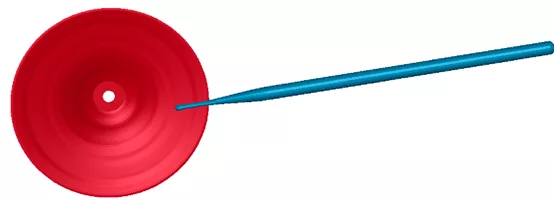
This research focuses on studying the vibroacoustic behaviour of percussion musical instruments, with an emphasis on cymbals (crash, splash) and drum membranes. Through advanced computational simulations (FEM-BEM) and experimental techniques (ESPI, motion capture, impulse response measurements), we analyze how geometry, material, and striking conditions influence the produced sound. The goal is to develop tools for sound synthesis and design optimization.
VibroacousticsidiophonesmembranophonesFinite Element MethodBoundary Element Method
Overview
Percussion instruments, such as cymbals and drums, produce complex sounds with a rich frequency spectrum, which depend on numerous factors: geometry, thickness, material, striking method, and pre-strain (in membranes). Our research aims to decode this complexity through an integrated approach combining:
- Computational Simulations:We develop FEM-BEM models (e.g., using LS-DYNA software) to study vibrational behavior and sound radiation. We conduct:
-
-
- Modal Analysis:Calculation of eigenfrequencies and mode shapes.
- FRF (Frequency Response Function) Analysis:Studying the instrument’s response to harmonic excitation.
- Time Domain FEM-BEM Analysis:Simulating the temporal evolution of sound after an impact, incorporating real motion capture data.
-
-
- Experimental Recording:
-
-
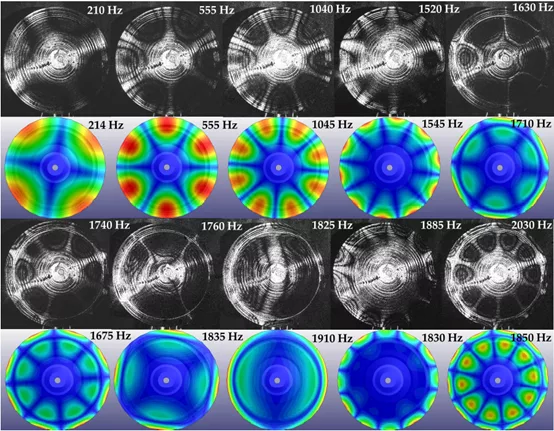
- Electronic Speckle Pattern Interferometry (ESPI):We visualize vibration mode shapes with nanometer accuracy, confirming the accuracy of FEM simulations.
- Motion Capture:We record the actual drumstick motion from professional drummers (at various dynamics, from piano to fortissimo) and use it as input for simulations, achieving realistic excitation modeling.
- Impulse Response Measurements:We use an impact hammer and accelerometers to measure FRFs and calculate the damping ratio.
-
-
- Sound Synthesis and Data Analysis: Our simulations allow us to calculate the sound pressure at any point in space and generate audio files (wav). We compare velocity spectrograms (on the instrument) with sound pressure spectrograms (in the air), revealing how structural vibration translates into audible sound.
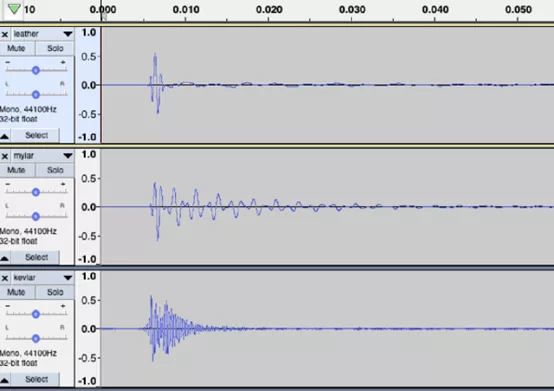
- Design Optimization: We parametrically investigate the effect of geometry (e.g., using arcs vs. lines to describe cymbal curvature), thickness, pre-strain, and materials (e.g., leather, Mylar, Kevlar, MS63, B8 alloys) on acoustic behaviour.
Our methodology lays the foundation for future physics-based sound synthesis and the creation of extensive sound databases for training machine learning models.
Examples
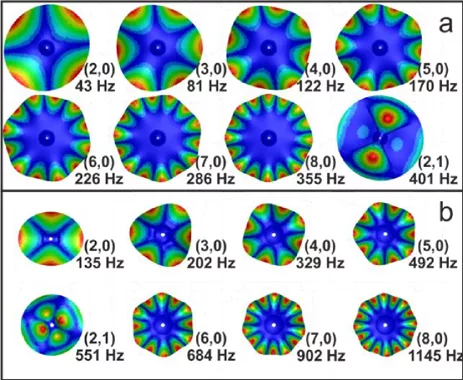
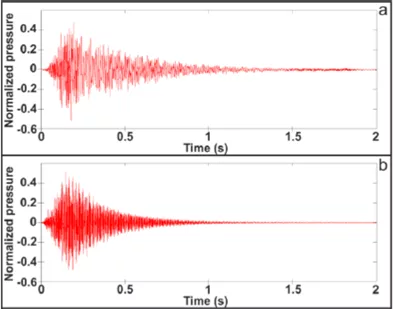
Crash vs. Splash Cymbal Comparison: Modal analysis results agree with literature. The splash cymbal shows higher frequencies for the same modes. The splash cymbal (b) exhibits higher frequencies for the same modes of vibration, while the oscillations of the sound pressure are attenuated faster in the case of the splash cymbal.
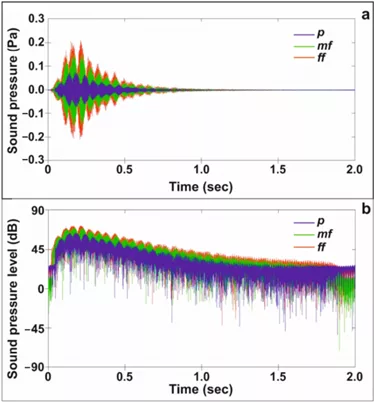
Simulation with Motion Capture Data: Drumstick motion was captured for p, mf, ff intensities. Velocity data were used as input for FEM-BEM simulations. A progressive increase in maximum SPL and decrease in attack time from p to ff is observed.
Parametric Analysis of Cymbal Geometry: Good agreement of vibroacoustic analysis results between simulations and experiments.
Drum Membrane Analysis: Audio signals generated for three types of membranes: a) Leather, b) Mylar, c) Kevlar drumheads
Publications
Brezas, S., Kaselouris, E., Orphanos, Y., Bakarezos, M., Papadogiannis, N.A., Dimitriou, V. (2025) On the Correlation of Cymbals’ Vibrational Behavior and Manufacturing Processes. Applied Sciences 15(3), 1425; https://doi.org/10.3390/app15031425
Brezas, S., Kaselouris, E., Orphanos, Y., Tatarakis, M., Bakarezos, M., Papadogiannis, N.A., Dimitriou, V. (2024). Vibrational Analysis of a Splash Cymbal by Experimental Measurements and Parametric CAD-FEM Simulations. Vibration, 7(1), 146-160. https://doi.org/10.3390/vibration7010008
Kaselouris, E., Paschalidou, S., Alexandraki, C., Dimitriou, V. (2023). FEM-BEM Vibroacoustic Simulations of Motion Driven Cymbal-Drumstick Interactions. Acoustics, 5(1), 165-176. https://doi.org/10.3390/acoustics5010010
Kaselouris, E., Alexandraki, C., Bakarezos, M., Tatarakis, M., Papadogiannis, N.A., Dimitriou, V. (2022). A detailed FEM Study on the Vibro-acoustic Behaviour of Crash and Splash Musical Cymbals. Int. J. Circuits Syst. Signal Process., 16, 948-955. https://doi.org/10.46300/9106.2022.16.116
Kaselouris, E., Alexandraki, C., Orphanos, Y., Bakarezos, M., Tatarakis, M., Papadogiannis, N.A., Dimitriou, V. (2021). Acoustic analysis of impact sound on vibrating circular membranes. INTER-NOISE 2021, Washington, DC, USA, 1-4 August 2021. https://doi.org/10.3397/IN-2021-2389
Research Team
Evaggelos Kaselouris, Assistant Professor
Vasilis Dimitriou, Professor
Nektarios Papadogiannis, Professor
Makis Bakarezos, Professor
Chrisoula Alexandraki, Associate Professor
Stella Paschalidou, Assistant Professor
Maximos Kaliakatsos Papakostas, Associate Professor
Michael Tatarakis, Professor
Giannis Orphanos, Laboratory Teaching Staff
Spyros Brezas, Postdoctoral Researcher, Acoustics Consultant
Despina Grigoriou, PhD Candidate
Dora Maroulaki, Undergraduate Student