
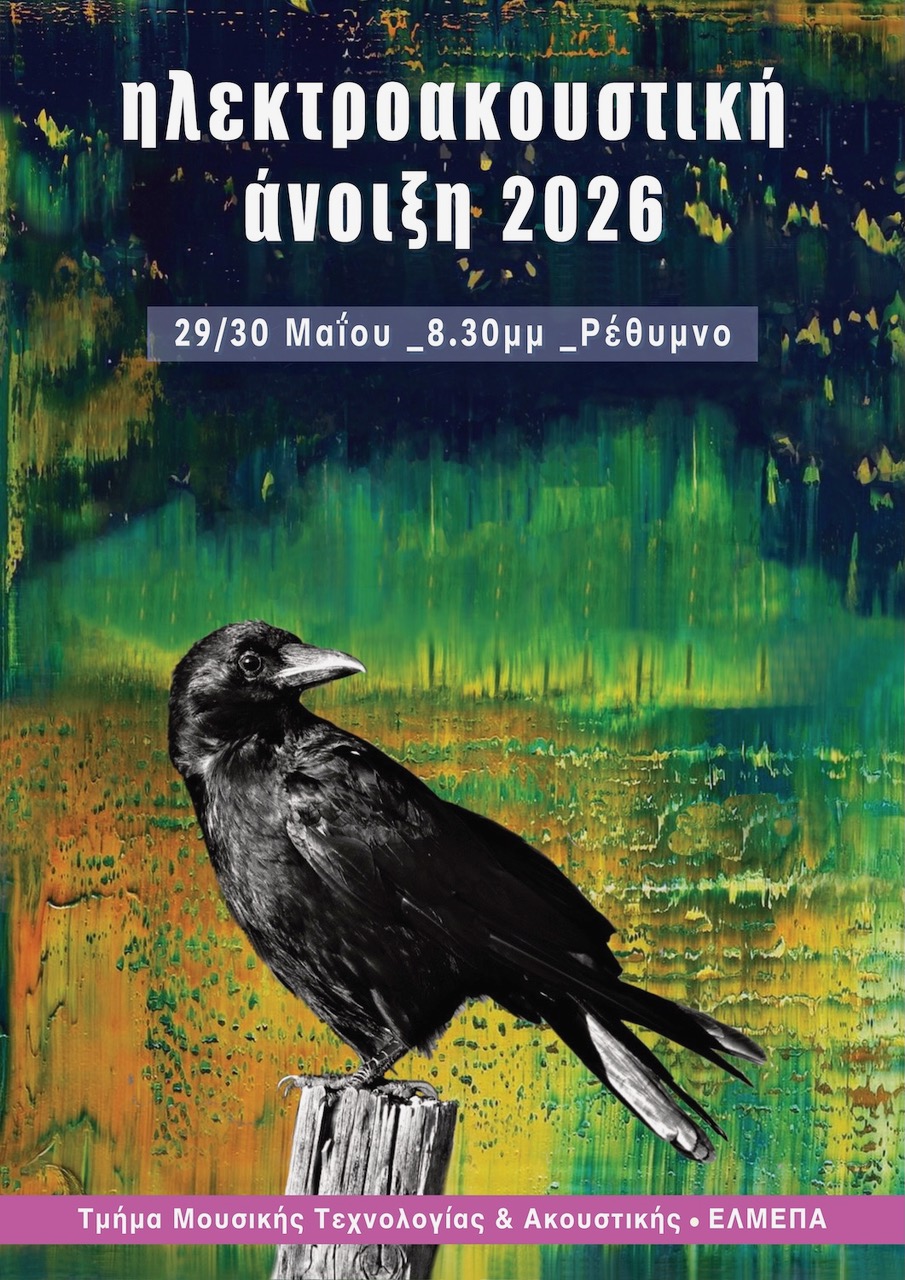
Ηλεκτροακουστική Άνοιξη 2026
29 & 30 Μαίου, 8.30 μμ.
Aμφιθέατρο Τμήματος Μουσικής Τεχνολογίας & Ακουστικής (ΕΛΜΕΠΑ), Ρέθυμνο
Η Ηλεκτροακουστική Άνοιξη είναι το ετήσιο (από το 2014) φεστιβάλ ηλεκτροακουστικής μουσικής στο Ρέθυμνο. Το πρόγραμμα περιλαμβάνει συνθέσεις από διάφορες τάσεις της ηλεκτροακουστικής / ακουσματικής μουσικής όπου παρουσιάζονται πρόσφατα αλλά και παλαιότερα έργα του διεθνούς ρεπερτορίου. Tα έργα παίζονται με ορχήστρα ηχείων περιμετρικά του ακροατηρίου.
Η Ηλεκτροακουστική Άνοιξη 2026 περιλαμβάνει ένα ειδικό αφιέρωμα στον Ανδρέα Μνιέστρη, μια συναυλία με έργα της Βέλγικης Ομοσπονδίας Ηλεκτροακουστικ΄ς Μουσικής (FeBeMe) καθώς και έργα μελών της Διεθνούς Συνομοσπονδίας Ηλεκτροακουστικής Μουσικής (CIME/ICEM) και του Eλληνικού Συνδέσμου Συνθετών Hλεκτροακουστικής Mουσικής (ΕΣΣΗΜ). Συνολικά θα παρουσιασθούν έργα των Ανδρέα Μνιέστρη, Bruno Abt, Roelandt Luyten, Victor Outters, Sophie Delafontaine, Dirk Veulemans, Edmar Soria, Mario Mary, Jon Christopher Nelson, John Young, João Pedro Oliveira, Στέλιου Ζουμαδάκη, Σπύρου Πολυχρονόπουλου, Δημήτρη Μπαρνιά, Νικόλα Βαλσαμάκη και Κατερίνας Τζεδάκη.
Υπεύθυνοι του φεστιβάλ είναι ο Νικόλας Βαλσαμάκης και η Κατερίνα Τζεδάκη.
Παρασκευή 29 Mαίου
Concert A1
Edmar Soria – Post Anthropocene Record No. X.01 (2025) 10:17 [8 channel]
Mario Mary – Pedro en su Laberinto (2023) 10:10 [8 channel]
Jon Christopher Nelson – Toward the Event Horizon (2022) 09:01
John Young – Le Chant en Dehors (2022) 10:07 [8 channel]
João Pedro Oliveira – Pulses (2025) 08:54 [8 channel]
Concert A2
Bruno Abt – Keramikos – Rituel de l’Air (2024) 11:35 [8 channel]
Roelandt Luyten – Viscosités (2024)10:02 [8 channel]
Victor Outters – Pour lui prendre sa bague, ils lui ont cisaillé le doigt (2021) 09:30
Sophie Delafontaine – Bouffée (2024) 14:00
Dirk Veulemans – De Zandman (2007/2025) 09:54 [8 channel]
Σάββατο 30 Mαίου
Concert B1
Στέλιος Ζουμαδάκης – Alien Signals from my Freezer (2026) 07:11
Σπύρος Πολυχρονόπουλος – Feeling of Movement (2011) 04:41
Marta Domingues – A Cathartic Postcard (2024) 09:36 [8 channel]
Δημήτρης Μπαρνιάς – A Handful of Nothing (2026) 07:28 [4 channel]
Νικόλας Βαλσαμάκης – SpinDec (2026) 08:40 [8 channel]
Κατερίνα Τζεδάκη– ANS (2026) 13:00 [8 channel]
Concert B2
Ανδρέας Μνιέστρης – Μαγράδια τοις ρυϊνοίοις επέρρωγον (1986-87) 06:11
Ανδρέας Μνιέστρης, Simona Sarchi – Αόρατες Πόλεις – Μέρος 1ο (1999/2007) 30:38 [6 channel]
Ανδρέας Μνιέστρης – Ελεύθεροι Συνειρμοί: Ζούγκλα (2017) 03:45
Ανδρέας Μνιέστρης, Simona Sarchi – Naturae/Continua – Part II (2023) 09:43 [8 channel]
________________________________________________________________
Concert A1
Edmar Soria – Post Anthropocene Record No. X.01 (2025) 10:17 [8 channel]
In 1950, Alan Turing published his famous article entitled “Computing machinery and intelligence” in which, among other things, he proposed the so-called “imitation game” in order to establish a type of heuristic with which it would be possible to know whether or not a machine exhibits intelligent behavior. The article begins with the powerful and forceful question: can a machine think? A little more than 70 years later and after the long road travelled in the study and development of artificial intelligence systems, a new question is proposed here: Can a machine dream? In that sense, this acousmatic work represents (from a speculative point of view) the experiential record of the first machine that was able to dream, some time ahead in a unknown future. And so, this works place us at the first person´s perspective of its first dream.
Mario Mary – Pedro en su Laberinto (2023) 10:10 [8 channel]
This composition is a proposal with a high density of sound materials and few breaths. The work displays an indefatigable energy through an articulate and vital polyphonic discourse. The multiple trajectories and sound planes generate a rich and changing acoustic space around the listener. All this complexity could be linked to life itself, in which, without realizing it, we progressively create our own labyrinths and the terrains where our deepest joys and conflicts develop.
Jon Christopher Nelson – Toward the Event Horizon (2022) 09:01
Toward the Event Horizon conceptualizes what might transpire as sound waves approach the event horizon of a black hole, where time slows down and a sound’s very existence becomes stretched beyond recognition. In this work, spectral elements of sounds are temporally and registrally manipulated, disintegrated and reconstituted. The resulting soundscape attempts to create a sense of slow and massive sounds that are wrenched apart. While arguably there is no sound in the vacuum of space, NASA scientists have noted that the black hole at the center of the Perseus galaxy releases pressure waves that cause subsonic ripples in the cluster’s hot gas. While nearing the completion of this movement, NASA released an audio sonification of these black hole pressure waves. NASA’s sonification is included in the final moments of this composition. This work constitutes one of six movements of the larger work, The Persistence of Time and Memory.
John Young – Le Chant en Dehors (2022) 10:07 [8 channel]
Le Chant en Dehors creates an atmosphere of evolving connection between sonorities of definite and indefinite pitch, or ‘tone’ and ‘noise.’ The title is taken from an instruction used by the French composer Francis Poulenc, meaning ‘bring out the tune.’ That idea is reflected in this work whereby strands of pitch — as resonance or attack morphologies — coalesce to imply states of linear or spectral connectedness as emergent melodic or harmonic strands. The spatial setting of the work exploits ways in which noise-based material tends to be more active within the three-dimensional frame than focally pitched / resonant sounds. In Le chant en dehors these contrasting types of sonority are placed in changing patterns of interaction to evoke waves of tension and release.
João Pedro Oliveira – Pulses (2025) 08:54 [8 channel]
Pulses is an acousmatic piece based on the iteration of different pulses, in many different contexts, and transformations.
Concert A2
Bruno Abt – Keramikos – Rituel de l’Air (2024) 11:35 [8 channel]
Electroacoustic piece in several movements, composed and spatialised in 8 tracks or in stereophony, from the transformed recordings of the ceramic sounds produced by Aude de Vinck (daughter of Antoine de Vinck), Alice de Vinck (wife of Antoine de Vinck), Bruno Abt, and Dominique Lion, a potter in Puisaye. ‘Born of earth and water, by air and fire, the ceramic object is perceived as holistic, as part of the whole world. All primitive ceramics, even utilitarian ones, have this cosmic, and therefore sacred, character. Forms and decorations contribute to making them microcosms, that is to say objects of art, objects charged with potentialities, with meanings. (…)’ Antoine de Vinck. The piece was created as a ritual invoking a ceramic god, Keramikos, imagined by the composer. It unfolds in the time and sound space of the 8 eight loudspeakers, making audible a composed and organised counterpoint of transformed sounds, from the recordings of the various stages of the creation of the ceramic object: preparation of the raw earth, turning, glazing, firing, unloading… In this musical composition, the ceramicist is seen as a mage who, by invoking the god, joins with him to shape the ceramic through the four elements. One should not look for a literal illustration of the creative process, consisting of a systematic recognition of the raw sounds of the workshop, ordered chronologically, but rather as a symbolic interpretation of this process through a musical journey to the heart of the material. Most of the sounds captured with the microphone were transformed in the studio, as in an alchemical laboratory of sound – and this in resonance with the transformation of the earth and the glazes which, through the gestures of modelling, rubbing and firing, become the ceramic object. The piece is is originally composed of two parts :
Ritual of the Air – Turning – Shaping – 11’35
The Chamber of Fire – Firing – Eutectic – 7’46
Ritual of the Air – Turning – Shaping. This section develops a musical texture woven from the various transformations of the recordings of mechanical and electric turning – the sound of the motor, of the rotation, the rubbing of the ceramicist’s utensils, the gestures of the turning – by the ceramicist Dominique Lion. The whole forms an incantatory chant evolving by gradation, punctuated by the percussion of the recordings of the beating of the earth. Evolving through the hypnotic movement of the rotation, the texture reaches a final section in which we can hear excerpts from an interview with Antoine de Vinck, whose words are interwoven with the music in a vibrant counterpoint.
Roelandt Luyten – Viscosités (2024)10:02 [8 channel]
Viscosités is an electroacoustic composition that explores auditory density through the interaction and fusion of sound textures. As the second part of a cycle inspired by states of matter, the work takes its inspiration from the physical property of viscosity—the resistance of a fluid to flow or deformation—translating this concept into the sonic domain. Sound is treated as matter whose internal density and resistance can shift continuously, creating impressions of fluidity, thickness, and suspension. The piece emphasizes timbre, texture, and gradual transformation. Different layers of sound interact much like molecules in varying states of matter, alternately flowing freely, slowing, colliding, or coagulating into denser forms. These interactions define the musical structure, allowing the listener to perceive changes in pressure, weight, and motion through sound alone. Through processes of layering, filtering, spectral shaping, and spatial control, sonic materials are shaped to continuously shift between transparency and opacity. Subtle changes in density alter how sounds merge or resist one another, creating a dynamic balance between movement and inertia. Viscosités invites a focused listening to the behavior of sound as fluid matter, revealing how minute changes at the micro level can reshape the perception of the overall sonic field. The piece was produced at the Musiques & Recherches studio in March 2024.
Victor Outters – Pour lui prendre sa bague, ils lui ont cisaillé le doigt (2021) 09:30
Each scar has a story behind it. Between the moment of injury and the wounds finally closed, long processes take place. Behind this title (meaning in English, “to take their ring, they cut off their finger”) lies a study on the theme of suturing, infection, rejection, or more generally, the struggle to adapt to the unforeseen.
Sophie Delafontaine – Bouffée (2024) 14:00
Bouffée draws its inspiration from an intense personal experience: that of giving birth. Through this composition, I sought to translate into sound the sensations of contractions, held breath, concentration, and the trance-like state that accompanies such an event. The core of the sonic material is based on the sounds of the Babel Table. The Babel Table is an original instrument created by Jean-François Laporte (Productions Totem Contemporain, Montreal). He invites artists to compose for his singular creations, and it was in this context that he welcomed me for a composition residency in Montreal. The original mixed version of Bouffée was premiered on November 2, 2023. In 2024, I undertook a reworking of the piece into a purely acousmatic version. Powered by an air compressor, the Babel Table sends air through various tubes and membranes. This makes it possible to produce (among other things) continuous sounds, similar to those of an organ or bagpipe. The duration of the sound is not limited by human breath. These unique sonic qualities were essential in helping me convey my sensations during childbirth. The sustained continuity of certain sounds blurs the listener’s sense of time. This loss of temporal reference reflects my own experience during labor, when minutes seemed to stretch out or disappear entirely. Despite the intense and sometimes noisy moments that shape the piece, I perceive a hidden softness within this music, and I hope that you will be able to perceive it as well.
Dirk Veulemans – De Zandman (2007/2025) 09:54 [8 channel]
For centuries, humans have felt the urge to recreate themselves. To construct an image that resembles themselves as closely as possible. In 2007, the theatre collective In Vitro (with Jan Dekeyser and Dafne Kitschen) explored this theme in a theatre production based on the 19th-century tale *Der Sandmann* by E.T.A. Hoffmann, a writer of fantastical and bizarre stories. In Hoffmann’s Der Sandmann, there is a deep connection between, on the one hand, the childish fear of the Sandman who sprinkles sand into children’s eyes and then abducts them, and, on the other hand, Nathanael’s, the central figure, obsessive infatuation with a female mechanical automaton that seems enlivened by artificial eyes. A 19th-century precursor to our current obsession with AI. Both motifs revolve around the eye as an element of perception, illusion and vulnerability. Together, they lead to Nathanael’s madness and downfall. The play employed 19th-century imagery in a contemporary manner. The same applies to the soundscape in this composition, which could be heard in 8-channel surround sound at the climax of the performance.
Concert B1
Στέλιος Ζουμαδάκης – Alien Signals from my Freezer (2026) 07:11
Το κομμάτι γράφτηκε μεταξύ Φλεβάρη και Μάρτη του 2026. Οι περισσότεροι ήχοι προέρχονται από την κατάψυξη του ψυγείου μου”
Σπύρος Πολυχρονόπουλος – Feeling of Movement (2011) 04:41
Όλα τα όργανα (πιάνο, κιθάρα, τύμπανα, κοντραμπάσο, τσέλο, κλαρινέτο, μπάσο κλαρινέτο και ηλεκτρικό μπάσο) που ακούγονται σε αυτό το άλμπουμ, ηχογραφήθηκαν σε διαφορετικά δωμάτια ή στούντιο. Η βασική ιδέα ήταν να επιτευχθεί μια παράξενη αίσθηση κίνησης στον χώρο και στον χρόνο, ακούγοντας αυτή την άμεση μετάβαση από το ένα δωμάτιο στο άλλο.Έχουμε συνηθίσει να βλέπουμε και να ακούμε αυτήν την εναλλαγή στον κινηματογράφο, όταν η μία σκηνή διαδέχεται την άλλη. Εάν η πρώτη σκηνή βρίσκεται σε ένα μικρό δωμάτιο και η επόμενη σε ένα μεγάλο, καταλαβαίνουμε ότι μεταφερθήκαμε σε έναν μεγαλύτερο χώρο αρχικά βλέποντάς το στην οθόνη και έπειτα ακούγοντάς το από τα ηχεία.Στον πραγματικό κόσμο, ακόμα και αν έχουμε τα μάτια μας κλειστά, μπορούμε να καταλάβουμε το μέγεθος του δωματίου στο οποίο βρισκόμαστε από την αντήχησή (reverb) του, ενώ δεν είναι εφικτό να ακούσουμε στιγμιαίες μεταβάσεις αντήχησης. Ο στόχος λοιπόν σε αυτό το άλμπουμ ήταν να επιτευχθεί αυτό το εφέ μόνο μέσω του ήχου.Η μετακίνηση από το ένα δωμάτιο στο άλλο μού δίνει την αίσθηση ότι η μουσική κινείται τόσο στον χώρο όσο και στον χρόνο. Όταν ακούμε μουσική, σκεφτόμαστε τον χρόνο ως μια αναγκαία και γραμμική μεταβλητή, αλλά καθώς πειραματιζόμουν με τη μίξη αυτών των διαφορετικών χώρων και τη στιγμιαία μετάβαση από τον έναν στον άλλον, απέκτησα μια παράξεμη αίσθηση του χρόνου ως μη γραμμικής μεταβλητής, καθώς το κομμάτι εξελισσόταν.
Marta Domingues – A Cathartic Postcard (2024) 09:36 [8 channel]
To write this piece, I asked percussionist Francisco Cipriano to record a free improvisation, without musical guidelines or which instruments to use. The challenge I set myself was to work solely with this sound material and create a piece with no other sounds except his. The search to re-combine and recompose the sound world I was given resulted in a cathartic musical postcard, from me to the listener.
Δημήτρης Μπαρνιάς – A Handful of Nothing (2026) 07:28 [4 channel]
Θραύσματα ήχων και λόγου από τον κόσμο του John Cage, όπως περιγράφεται στο κείμενο του, ‘A Lecture on Nothing’. Σχεδιασμένο αλγοριθμικά, υποβοηθούμενο σε σημεία από τον συνθέτη.
Νικόλας Βαλσαμάκης – SpinDec (2026) 08:40 [8 channel]
Το SpinDec (2026)είναι μια μικροηχητική σύνθεση για 8 κανάλια. Εξερευνά τον κύκλο ζωής ηχητικών σωματιδίων: ατάκες, περιστροφές, χωρικoί χοροί, συγκρούσεις, αποσβέσεις και μετασχηματισμοί. Ιδιαίτερη έμφαση δίνεται στην έννοια της απόσβεσης (decay) των γεγονότων. Ενώ στον ήχο η απόσβεση περιγράφει τον ρυθμό με τον οποίο μειώνεται η ένταση ενός ήχου, στη σωματιδιακή φυσική ο όρος έχει μια ιδιαίτερη σημασία: αναφέρεται στην στιγμιαία διαδικασία μέσω της οποίας ένα ασταθές υποατομικό σωματίδιο μετασχηματίζεται σε πολλαπλά άλλα σωματίδια. Όλο τo ηχητικό υλικό έχει παραχθεί με μια προσωπικά σχεδιασμένη, μη-τυπική, ειδική αλγοριθμική διαδικασία (non-standard algorithmic procedure) για τον απευθείας υπολογισμό της κυμματομορφής και τη σύνθεση ηχητικών μικρομορφών. Οι μουσικές φράσεις έχουν κατασκευαστεί μέσω μικρο-μοντάζ και εκτεταμένων κοκκοειδών μετασχηματισμών.
Κατερίνα Τζεδάκη– ANS (2026) 13:00 [8 channel]
Η κύρια ιδέα του έργου σχετίζεται με ένα σύμπαν που πάλλεται και αναδιπλώνεται δημιουργώντας χώρους. Το έργο βασίστηκε σε ηχητικούς αυτοσχεδιασμούς με το λογισμικό Virtual ANS σε υπολογιστή και κινητό.
Concert B2
Ανδρέας Μνιέστρης – Μαγράδια τοις ρυϊνοίοις επέρρωγον (1986-87) 06:11
«Μαγράδια τοις ρυϊνίοις επέρρωγον»: η υπερλεξιστική αυτή πρόταση ήρθε και εγκαταστάθηκε με το ‘έτσι θέλω’ σαν τίτλος στο πρώτο μου κομμάτι για μαγνητοταινία, αμέσως μετά την ολοκλήρωσή του στο στούντιο GES-Vierzon, στη πόλη Vierzon της κεντρικής Γαλλίας, τον Απρίλη του ‘87. ‘Εχω κατά καιρούς γράψει σε διάφορα σημειώματα συναυλιών ότι αυτό το κομμάτι είναι: «ένας ύμνος στο β’ θερμοδυναμικό αξίωμα», «μία πικρή διαμαρτυρία», «ένα τραγούδι concrète» (αν είναι ποτέ δυνατόν!), «άσκηση στις τεχνικές της μουσικής για μαγνητοταινία» και πολλά άλλα. Είναι όλα τους αλήθεια και έτσι, με όλα τους μαζί συγκεντρωμένα στην ίδια παράγραφο για πρώτη φορά, εντείνεται η υπερλεξικότητα του τίτλου φτάνοντας μέχρι τα όρια της ‘παταφυσικής. Τα λόγια που ακούγονται στο βάθος αριστερά («έγινα ο καραγκιόζης που κορόϊδευα»…κτλ.) ειχαν γραφτεί σε ανύποπτο χρόνο από τον κ. Παναγή Μπίκουλα – του οποίου στίχους έχω χρησιμοποιήσει και σε άλλα μου κομμάτια και τον οποίο ευχαριστώ πολύ. Στο τεχνικό επίπεδο το κομμάτι παρουσιάζει αρκετές ατέλειες· πολύ φυσικά, αφού είναι μια πρώϊμη σπουδή στις τεχνικές σύνθεσης με μαγνητοτανία (ΣΗΜ: στις μέρες μας, όπου ο ηλ. υπολογιστής είναι το αυτονόητο εργαλείο, πρέπει να υπενθυμίσω ότι για περίπου σαράντα χρόνια, από το 1950, οι συνθέτες της ηλεκτρονικής μουσικής δημιουργούσαν τα έργα τους κόβοντας και μοντάροντας κομμάτια μαγνητοταινίας). Παρά τις όποιες ατέλειες όμως, ή ίσως εξαιτίας τους, το κομμάτι αποπνέει έναν ανεπιτήδευτο αυθορμητισμό. Έτσι, όταν μου ζητήθηκε να το συμπεριλάβω σε αυτό το πρόγραμμα, δέχτηκα αμέσως.
Ανδρέας Μνιέστρης, Simona Sarchi – Αόρατες Πόλεις – Μέρος 1ο (1999/2007) 30:38 [6 channel]
Tο 1999 πραγματοποιήθηκε στην Kέρκυρα μια έκθεση εικόνων τυπωμένων σε ύφασμα (εν είδει βουδιστικών Thangka). Oι εικόνες αυτές ήταν αποτέλεσμα ψηφιακής επεξεργασίας μερικών χαρακτηριστικών φωτογραφιών επιλεγμένων από τα ρεπορτάζ που είχε πραγματοποιήσει η Simona –σε συνεργασία με τον Giorgio Bondi– τη δεκαετία του 1980 στη Μέση Ανατολή (Δυτική Ασία, για να είμαστε πολιτικά ορθοί). Oι επεξεργασμένες αυτές εικόνες, επηρεασμένες, άλλες περισσότερο άλλες λιγότερο, από τις «Aόρατες Πόλεις» όπως τις αφηγείται ο Ίταλο Kαλβίνο στο βιβλίο του, αποτελούν ένα φανταστικό ταξείδι με αφορμή την ανάμνηση των περιηγήσεων στους τόπους εκείνους -στη Συρία, την Ινδία, την Υεμένη, την Αίγυπτο και αλλού. Για την έκθεση αυτή είχα οργανώσει μια ηχητική εγκατάσταση, για τη σύνθεση του ηχητικού υλικού της οποίας χρησιμοποιήθηκαν ήχοι περιβάλλοντος, ήχοι διαφόρων αντικειμένων καθώς και αποσπάσματα απο ηχογραφήσεις των: Munir Bashir, Bismillah Khan, Khabi Abou-Khalil, Anouar Brahem, Belfast Harp Orchestra, Ali Akbar Khan, Hussein El Asry, Muhamad Qadri Dalal, Nusrat Fateh Ali Khan, Muddy Waters καθώς και λαϊκή και θρησκευτική μουσική απο την Iνδία, την Λιβερία και την Aιθοπία. Στόχος ήταν η δημιουργία ενός μη ρεαλιστικού ηχητικού περιβάλλοντος που αφενός να αλλάζει διαρκώς χωρίς όμως να επαναλαμβάνεται και αφετέρου να περνά τόσο απαρατήρητο όσο και το πραγματικό καθημερινό ηχητικό περιβάλλον μας, έτσι ώστε να συνοδεύει την περιπλάνηση των θεατών ανάμεσα στις εικόνες που ήταν τοποθετημένες στο χώρο της έκθεσης. Tο βίντεο που παρουσιάζουμε σήμερα βασίζεται στις εικόνες και τους ήχους της έκθεσης αυτής και προτείνει ένα παρόμοιο φανταστικό ταξείδι μόνο που τώρα είναι οι εικόνες και οι ήχοι σε κίνηση ενώ οι θεατές/ακροατές είναι που παρατηρούν ακίνητοι. Πολλοί από τους τόπους που εμφανίζονται στις εικόνες αυτές δεν υπάρχουν πια. Μετά από αναλεήτους βομβαρδισμούς και ακραίες βιαιότητες έχουν καταστραφεί και οι άνθρωποι που τους κατοικούσαν έχουν αναγκαστεί να εκπατριστούν βίαια. Ζούμε σε καιρούς που η πολιτική ορθότητα και η ωμή βία συμβιώνουν αρμονικά την ίδια στιγμή που ανθρώπινες κοινότητες και φυσικό περιβάλλον καταστρέφονται αμίλεικτα σε λάϊβ αναμετάδωση από τη τηλεόραση και το διαδίκτυο. Από την άποψη αυτή το έργο τούτο αποκτά μια αναπάντεχη, οδυνηρή, επικαιρότητα.
φωτογραφία: Simona Sarchi, Giorgio Bondi
βίντεο: Simona Sarchi
ηλεκτροακουστική μουσική: Aνδρέας Μνιέστρης
Ανδρέας Μνιέστρης – Ελεύθεροι Συνειρμοί: Ζούγκλα (2017) 03:45
Το κομμάτι αυτό είναι μια κλεφτή ματιά-μέσα-από-την-κλειδαρότρυπα προς ένα έργο πολύ μεγάλης διάρκειας που είναι οι Ελεύθεροι Συνειρμοί. Όπως και το «ογκώδες μυθιστόρημα» «Μενιδιάτες του διαστήματος» του συγγραφέα Πάνου Κουτρουμπούση που «έγινε γνωστός από την τεράστια συγγραφική εργασία του που θα εκτελέσει αργότερα», το έργο αυτό μένει να υλοποιηθεί εν καιρώ. Ωστόσο σήμερα έχουμε τη δυνατότητα να ακούσουμε τη «Ζούγκλα», ένα μικρό του μέρος που είχε ολοκληρωθεί στο πλαίσιο μίας συνεργασίας με το Τμήμα Music, Technology and Innovation (ΜΤΙ) του Πανεπιστημίου DeMontfort του Leicester της Αγγλίας. Η κατασκευή του κομματιού αυτού υπήρξε μέρος της εντατικής δοκιμής μιας νέας ψηφιακής εφαρμογής ( με όνομα: Composing With Sounds ) ειδικά φτιαγμένης για να τη χρησιμοποιούν μαθητές γυμνασίου σαν εργαλείο εκμάθησης των μεθόδων σύνθεσης ηλεκτροακουστικής μουσικής δουλεύοντας απευθείας με το ηχητικό υλικό. Πολλές ευχαριστίες στον Καθ. Leigh Landy, διεθυντή έρευνας του τµήµατος αυτού ο οποίος είχε την ιδέα για την εφαρµογή αυτή και διηύθυνε την υλοποίησή της µέσω ενός σχετικού ευρωπαϊκού προγράµµατος (πριν το ‘Βrexit’…εννοείται). Ως προς το περιεχόμενο, τώρα, αλλά και ως προς το ηχητικό της υλικό, η « Ζούγκλα » βασίζεται στην ίδια την απαγγέλουσα φωνή του Κώστα Βάρναλη και κυρίως στο ποίημά του « οι Μοιραίοι », των ανώνυμων χαρακτήρων του οποίου «…όσο κι ο νους να τυραννιέται, άσπρην ημέρα δε θυμιέται …». Το κοµµάτι αυτό πρέπει να εκληφθεί ως µέρος του ηχοτοπίου της, διαρκούς, ύφεσης και κατάθλιψης που πλήττει (τουλάχιστον) από το 2010 τη χώρα, αντηχώντας την αιώνια απόγνωση των µοιραίων του Βάρναλη. Στο τέλος μας ρωτάει ο ποιητής: «ποιός φταίει;…ποιός φταίει; » … έλα ντέ ! …
Ανδρέας Μνιέστρης, Simona Sarchi – Naturae/Continua – Part II (2023) 09:43 [8 channel]
Νaturae/Continua είναι ο προσωρινός τίτλος ενός τριμερούς οπτικοακουστικού έργου σε εξέλιξη (ό.π.). Εδώ παρουσιάζεται το 2ο μέρος του. Σχετίζεται χαλαρά με ενα κείμενο που μεταφράστηκε από τον T. H. Huxley και δημοσιεύτηκε ως “Nature: Aphorisms by Goethe” στη πρώτη έκδοση του περιοδικού Nature (Τομος 1, Τεύχος 1, 4/11/1869): « Nature! We are surrounded and embraced by her: powerless to separate ourselves from her, and powerless to penetrate beyond her. Without asking, or warning, she snatches us up into her circling dance, and whirls us on until we are tired, and drop from her arms. She is ever shaping new forms: what is, has never yet been; what has been, comes not again. Everything is new, and yet nought but the old. We live in her midst and know her not. She is incessantly speaking to us, but betrays not her secret. We constantly act upon her, and yet have no power over her ». Το έργο παίχτηκε για πρώτη φορά εδώ στο Ρέθυμνο τον Νοέμβριο του 2023 στο πλαίσιο των Ημερών Ηλεκτροακουστικής Μουσικής.
φωτογραφία, επεξεργασία εικόνας και βίντεο: Simona Sarchi
σύνθεση ηλεκτροακουστικής μουσικής: Aνδρέας Μνιέστρης